Tennis elbow: symptoms, exercises and treatment
Based on NHS guidance, last reviewed by the NHS on 31 May 2024.
Reviewed by Harvir Ubhi, HCPC-registered physiotherapist. Last reviewed 28 September 2026.
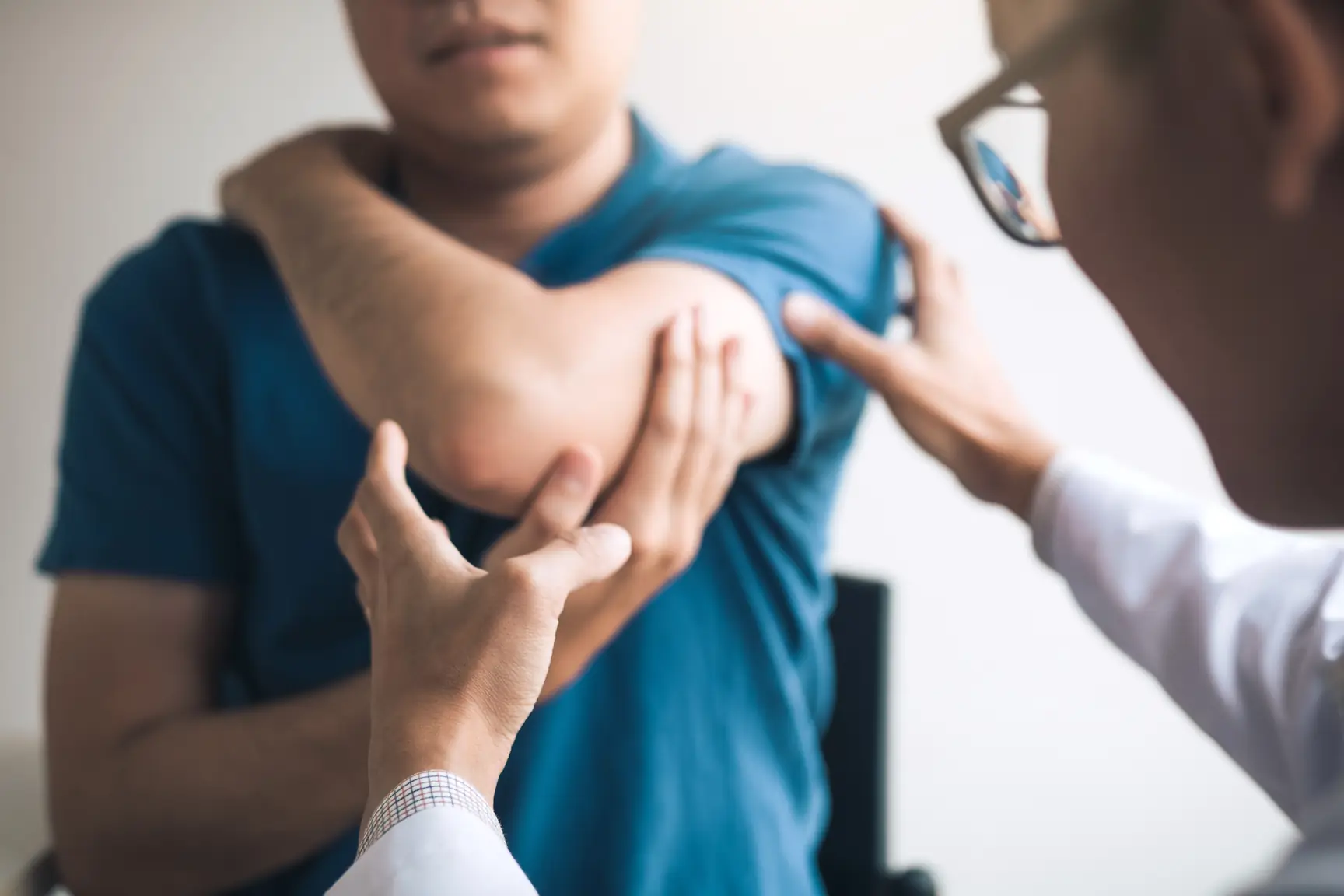
The short version: tennis elbow is pain on the outside of the elbow from repeated gripping and wrist movements. Most people who get it don't play tennis. It usually settles with rest, pain relief and exercises, though it can take up to a year. If it hasn't improved after 6 weeks of treating it yourself, physiotherapy is the NHS's next step.
What is tennis elbow?
Tennis elbow is pain around the outside of the elbow, where the tendons of your forearm muscles attach to the bone. Those tendons get strained and painful from repeated use. The medical name is lateral epicondylitis. Despite the name, you don't need to play tennis to get it: typing and using a mouse can cause it too.
Tennis elbow symptoms
- pain on the outside of the elbow
- tenderness or swelling in the elbow
- pain in the forearm
- difficulty straightening your arm fully
- pain that's worse when you lift, grip or move your wrist
What causes tennis elbow
Repeated gripping combined with twisting your wrist. The NHS lists:
- computer work, such as typing or using a mouse
- racket sports such as tennis
- playing a musical instrument
It's most common between 35 and 54. Smoking and carrying extra weight also raise the risk. It can start on its own, or after a change in what you do, like a new job, a DIY project or a new sport.
Tennis elbow treatment, in the order it usually happens
- 1
Rest the elbow
Avoid, or cut down on, whatever sets the pain off.
- 2
Pain relief
Paracetamol, or an anti-inflammatory gel rubbed onto the painful area. A pharmacist can tell you what's safe for you.
- 3
Hot or cold packs
Up to 20 minutes every 2 to 3 hours.
- 4
Simple exercises
Gentle arm and wrist exercises, like the stretch below.
- 5
A strap or brace
A forearm strap, or a wrist or elbow brace, can ease symptoms while you recover.
- 6
Physiotherapy
If it hasn't improved after 6 weeks of home treatment. The NHS says this can include massage, stretching and strengthening exercises, and ultrasound therapy.
- 7
Surgery
An option only if you still have tennis elbow after 6 to 12 months.
Tennis elbow exercises
Forearm stretch (from NHS Fife): straighten your elbow and let your wrist drop down, then gently press on the back of your hand with your other hand until you feel a stretch along the top of your forearm. Hold for 15 seconds and repeat 3 to 5 times.
Strengthening the forearm muscles is also part of recovery. Derby and Burton's NHS physios advise starting with a number of repetitions you can manage, 2 or 3 times a day, and making it harder over time. Some discomfort while you exercise is normal and safe. A physio can set the right starting level and progress it, so you don't give up too early or push too hard.
Seeing a physio for tennis elbow
You don't need a GP referral to see a private physio. In London a first appointment usually costs £70 to £130. Tell us about your elbow and a HCPC-registered physiotherapist on our team will match you with someone who treats elbow and arm pain regularly.
It's free, and most people hear back within 24 hours.
When to see a GP
The NHS says see a GP if the pain hasn't improved after resting your elbow and trying self-care for at least 2 weeks. A GP can prescribe anti-inflammatory tablets and refer you on if needed.
Tennis elbow questions
What does tennis elbow feel like?
Pain on the outside of your elbow, sometimes running into your forearm. It's worse when you grip, lift or twist your wrist, like opening a jar, shaking hands or using a mouse. The elbow can be tender to touch, and it can be hard to straighten your arm fully.
Is there a tennis elbow test?
There's no special test you need to book. A GP or physio can diagnose it by examining your elbow and forearm and checking which movements set the pain off.
Do tennis elbow straps and braces work?
They can help. The NHS suggests trying a forearm strap, or a wrist or elbow brace, and NHS Fife says a forearm clasp can help by taking pressure off the painful area. Use one alongside the exercises, not instead of them.
How long does tennis elbow last?
It usually goes away with rest, but the NHS says it can sometimes last over a year. Derby and Burton NHS physios say most people are better within a year, and that sticking with the exercises is what helps.
How do I get rid of tennis elbow?
Rest from what's causing it, pain relief, a strap if it helps, and exercises. If it hasn't improved after 6 weeks of treating it at home, the NHS says physiotherapy may help.
Related: shoulder pain · tingling in your fingers · trapped nerve in your neck
Sources
- NHS, Tennis elbow (last reviewed 31 May 2024). nhs.uk/conditions/tennis-elbow
- University Hospitals of Derby and Burton NHS Foundation Trust, Tennis elbow. uhdb.nhs.uk
- NHS Fife, Tennis elbow (lateral epicondylitis/osis). nhsfife.org
- London physio prices: PhysioMatch London survey of 20 clinics, September 2026
This page is general information, not medical advice. If you're worried about your symptoms, speak to a GP, call NHS 111, or in an emergency call 999.