Rotator cuff injury: symptoms, test and treatment
Based on NHS guidance and NHS physiotherapy leaflets.
Reviewed by Harvir Ubhi, HCPC-registered physiotherapist. Last reviewed 28 September 2026.
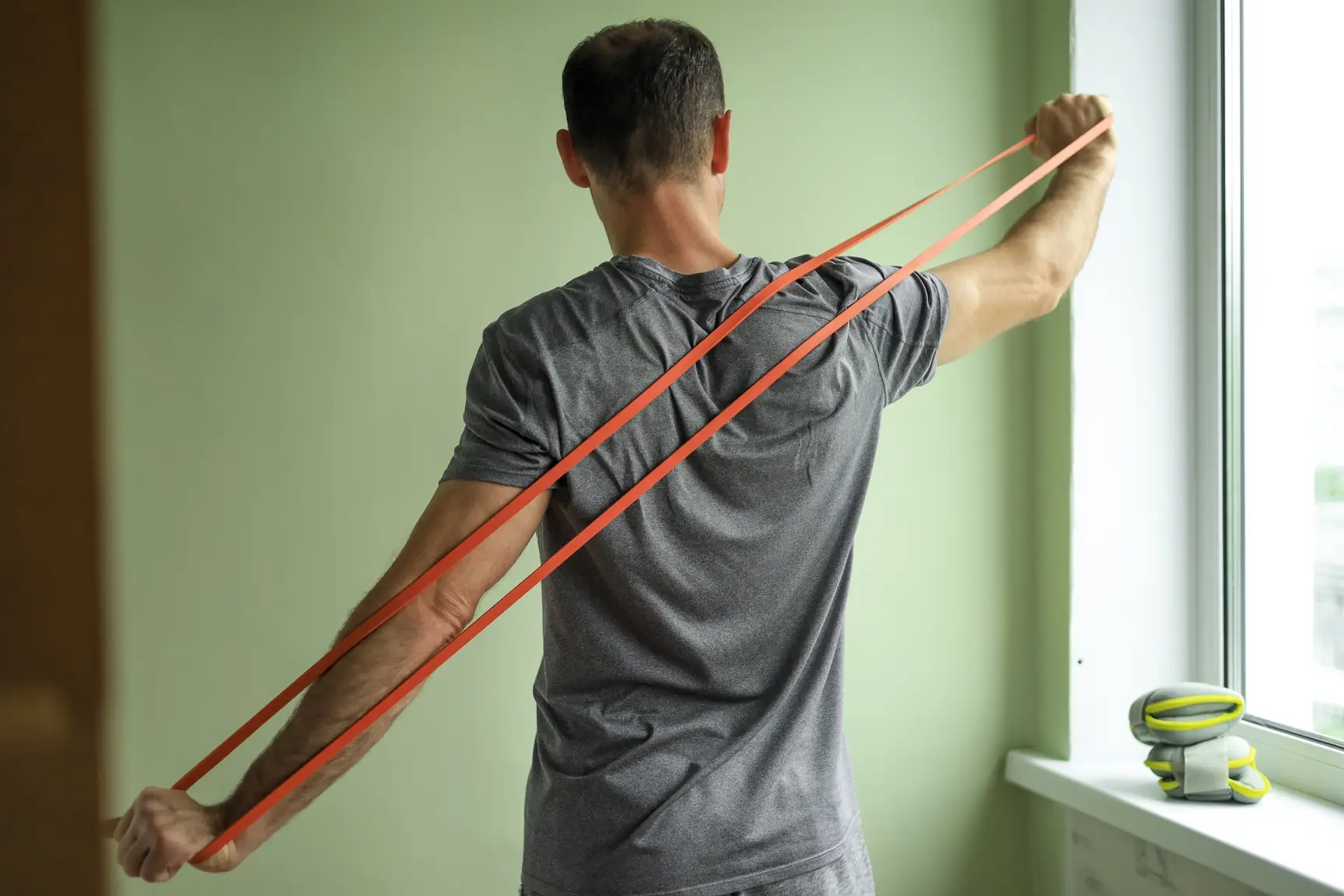
The short version: the rotator cuff is involved in about 70% of all shoulder pain. It hurts when you lift your arm, reach overhead or behind your back, and when you lie on that side. About half of people get better in around 6 months on their own. The rest do well with 3 to 6 months of the right exercises, which is where a physio comes in. Most people never need surgery.
What the rotator cuff is
Your rotator cuff is a group of four muscles and their tendons that wrap around the top of your arm bone and keep it steady in the shoulder socket. When the problem is coming from them, doctors and physios often call it rotator cuff related shoulder pain. It's an umbrella term for several problems in and around those tendons, and it affects men and women of all ages equally.
Rotator cuff injury symptoms
- pain in the upper arm, on the outside
- a catching pain
- pain reaching forwards, above head height or out to the side
- pain putting your hand behind your back, like tucking in a shirt or fastening a bra
- pain when you sleep or lie on that shoulder
If your shoulder is stiff as well as painful, and won't move far whichever way you try, read about frozen shoulder. If the pain starts in your neck and runs down your arm with tingling, it may be a trapped nerve in your neck.
Is there a rotator cuff injury test?
Not a single one. A GP or physio examines you, moves your arm in different directions and notes what brings the pain on. Scans are less helpful than people expect. Changes around the shoulder that show up on a scan are also found in people with no pain at all, so a scan result doesn't always explain your symptoms. That's why the examination matters more.
Rotator cuff injury treatment, in the order it usually happens
- 1
Keep moving
Stay active and gently move your shoulder. The NHS advises against keeping it still.
- 2
Painkillers, ice or heat
Paracetamol or ibuprofen. A bag of frozen peas in a tea towel for up to 20 minutes, 3 times a day, or a heat pack. A pharmacist can tell you what's safe for you.
- 3
Exercises
The NHS suggests shoulder exercises for 6 to 8 weeks to stop the pain coming back. A graded programme builds strength a step at a time.
- 4
Physiotherapy
A physio works out which movements your shoulder is struggling with and sets exercises at the right level, so you push enough to get stronger without flaring it up. Many areas also let you refer yourself to NHS physio.
- 5
Stronger medicine or an injection
A GP may offer these if painkillers aren't enough.
- 6
Specialist referral
If the pain doesn't settle.
Rotator cuff exercises from an NHS programme
These are the starting level of the four exercises in the Royal United Hospitals Bath physio programme. Start with 5 repetitions, build to 3 sets of 15, and do them 3 to 5 days a week with rest days in between. Once 3 sets of 15 feels manageable, you move to a harder version, which is the part a physio helps you judge.
- Weight shifts on all fours. Start on your hands and knees. Shift your weight slowly side to side, then forwards and backwards.
- Supported arm lift. Sit with your forearm resting on a table, holding a small weight. Lift your arm away from the table as far as is comfortable.
- Doorway press. Stand in a doorway with your arms by your sides. Press your hands outwards into the door frame and hold.
- Bent-over row. Lean forward with one hand on a table and a weight in the other. Lift the weight towards you by bending your elbow, then lower it slowly.
How much pain is OK? Keep it at 4 out of 10 or below. It should calm down within a few hours and not keep you awake. If it's still up the next day, you did too much: do a bit less next time rather than stopping altogether. Pain here doesn't mean you're damaging your shoulder.
Seeing a physio for your shoulder
You don't need a GP referral to see a private physio. In London a first appointment usually costs £70 to £130. Tell us what's going on with your shoulder and a HCPC-registered physiotherapist on our team will match you with someone who treats rotator cuff problems regularly.
It's free, and most people hear back within 24 hours.
When to see a GP
The NHS says see a GP if:
- shoulder pain is getting worse, or hasn't improved after 2 weeks
- it's very difficult to move your arm or shoulder
Rotator cuff questions
Is there a test for a rotator cuff injury?
There's no single test that settles it. A GP or physio examines you and watches which movements bring the pain on. Scans are less useful than people expect: the RUH Bath leaflet points out that the changes scans pick up around the shoulder are also found in people with no pain at all.
How long does a rotator cuff injury take to heal?
RUH Bath's physio team says about half of people get better in around 6 months without any treatment. The other half do rehab exercises, which usually takes 3 to 6 months to settle the pain, and they do well.
Do I need a sling?
Not for everyday rotator cuff pain. NHS advice is to stay active and keep gently moving your shoulder.
Is it safe to exercise with a rotator cuff injury?
Yes, and it's the main treatment. The RUH Bath rule of thumb: some pain while you exercise is fine if it stays at 4 out of 10 or below, settles within a few hours, and doesn't disturb your sleep. If it does, do less next time rather than stopping.
What causes a rotator cuff injury?
Often there's no single cause. The RUH Bath physio team lists things that make shoulder pain worse and slower to settle: poor sleep, high stress, carrying extra weight, a lot of alcohol, smoking and not being very active.
Related: shoulder pain: causes and where it hurts · frozen shoulder · private physio costs
Get urgent help
Call 999 if you have chest pain that feels tight or like squeezing, or chest pain spreading to your arms, neck or jaw. It can be a heart attack.
Call NHS 111 or get an urgent GP appointment if:
- the pain is sudden and very bad, or you can't move your arm
- your shoulder has changed shape
- you have pins and needles or numbness that won't go away
- it started after an injury, such as a fall
- you have a high temperature
Sources
- Royal United Hospitals Bath NHS Foundation Trust, Rotator cuff related shoulder pain (PHY049, August 2021). ruh.nhs.uk
- NHS, Shoulder pain (last reviewed 22 May 2023). nhs.uk/conditions/shoulder-pain
- NHS, Heart attack symptoms. nhs.uk/conditions/heart-attack/symptoms
- London physio prices: PhysioMatch London survey of 20 clinics, September 2026
This page is general information, not medical advice. If you're worried about your symptoms, speak to a GP, call NHS 111, or in an emergency call 999.