Plantar fasciitis treatment: what helps heel pain get better
Based on NHS guidance and NHS physiotherapy leaflets.
Reviewed by Harvir Ubhi, HCPC-registered physiotherapist. Last reviewed 28 September 2026.
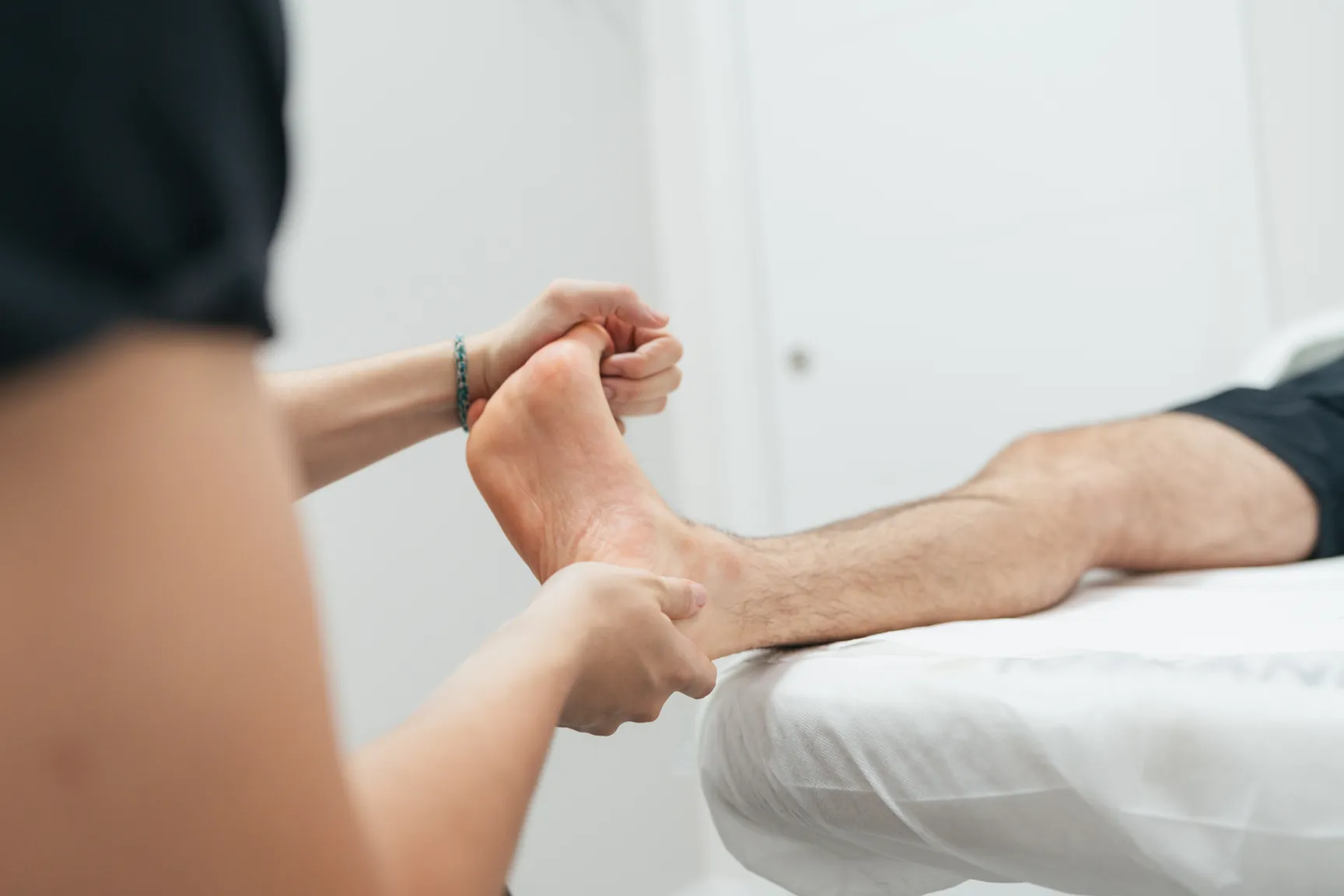
The short version: plantar fasciitis is pain under your heel and arch, usually worst with your first steps in the morning. It gets better slowly, often over a year or more, but 80 to 95% of people recover without surgery. Stretching, better footwear and taking some load off your feet do most of the work. A physio can speed that up when it isn't shifting.
What is plantar fasciitis?
The plantar fascia is a thick band of tissue running along the sole of your foot, from your heel to the base of your toes. It supports your arch and absorbs shock when you walk. Plantar fasciitis is when that band becomes painful from repeated small strains that don't fully heal. Some NHS leaflets call it plantar fasciopathy. It's the same thing.
Symptoms
- sharp pain between your arch and heel
- worse when you start walking after rest, especially first thing in the morning
- better when you rest, but back after standing or walking for a long time
- difficulty lifting your toes off the floor
What causes it
- a sudden increase in activity, such as starting to run
- standing for long periods, often for work
- carrying extra weight
- high arches or flat feet
- tight calf muscles
- shoes with poor cushioning or support
- getting older
Plantar fasciitis treatment, in the order it usually happens
- 1
Take the load off
Rest and raise your heel when you can. Swap running and long walks for swimming or cycling while it settles.
- 2
Ice
An ice pack or bag of frozen peas wrapped in a towel on your heel for up to 20 minutes, every 2 to 3 hours.
- 3
Stretch every day
Calf and sole stretches are the main treatment. There are 7 from an NHS physio leaflet below.
- 4
Change your shoes
Wide, comfortable shoes with a low heel, a soft sole and good arch support. Avoid high heels, flip-flops and backless slippers. Soft insoles or heel pads can help.
- 5
Painkillers
Paracetamol, or ibuprofen gel on the heel. A pharmacist can tell you what's safe for you.
- 6
Physiotherapy
If it isn't improving, a physio checks what's overloading your foot, from tight calves to your foot shape and footwear, and progresses your exercises. Many areas let you refer yourself to NHS physio.
- 7
Further options
For pain that won't settle, doctors may try night splints, a steroid injection (often painful, and the benefit can wear off) or shockwave therapy. Surgery is a last resort.
7 plantar fasciitis exercises from an NHS leaflet
These come from Hull University Teaching Hospitals NHS Trust's patient leaflet. Stretch gently: you should feel a pull, not sharp pain.
- Calf stretch, straight leg. Face a wall with the sore foot behind you, leg straight and heel down. Bend your front knee until you feel the stretch in your calf. Hold 30 seconds, 3 times a day.
- Calf stretch, bent knee. Same position, but bend both knees, keeping the heel of the sore foot on the floor. Hold 30 seconds, 3 times a day.
- Step stretch. Stand with the balls of your feet on a step and your heels hanging off the edge. Keep your knees straight and let your heels drop. Hold 30 seconds, twice per session.
- Seated sole stretch. Sit down and lift your toes upwards while keeping your heel on the floor. Hold 30 seconds, 3 times per session.
- Towel stretch. Sit with your leg straight, loop a towel around the ball of your foot and gently pull your toes towards you. Hold 30 seconds, 3 times per session.
- Frozen bottle roll. Sitting down, roll the arch of your foot back and forth over a frozen water bottle for 5 minutes, twice a day.
- Heel raises. Holding a chair, push up onto your toes as high as you can. Hold 5 seconds and repeat 10 times, twice a day. When that's easy, do it on one leg.
Seeing a physio for heel pain
You don't need a GP referral to see a private physio. In London a first appointment usually costs £70 to £130. Tell us about your heel and a HCPC-registered physiotherapist on our team will match you with someone who treats foot and heel pain regularly.
It's free, and most people hear back within 24 hours.
When to see a GP
The NHS says see a GP if:
- the pain is severe or stopping you doing normal activities
- the pain is getting worse or keeps coming back
- it hasn't improved after 2 weeks of treating it at home
- you have tingling or loss of feeling in your foot
- you have diabetes and heel pain
Plantar fasciitis questions
How long does plantar fasciitis last?
It's slow. Milton Keynes University Hospital puts the average at around 18 months. The same leaflet says 80 to 95% of people get better without surgery, using stretches, the right footwear and time.
Why is it worst first thing in the morning?
The pain typically flares when you start walking after rest, such as your first steps out of bed or standing up after sitting. It often eases a little once you get moving, then comes back after long periods on your feet.
Do insoles work for plantar fasciitis?
They can help. The NHS suggests soft insoles or heel pads, and specialist insoles can reduce the load on the tissue. They work best alongside stretching, not instead of it. If insoles are your main question, a podiatrist (a foot specialist) is also worth seeing.
Can I keep running with plantar fasciitis?
The Hull NHS leaflet advises avoiding running and a lot of walking while it's painful, and swapping to swimming or cycling to stay fit without loading your heel.
Can plantar fasciitis be cured in a week?
No. Searches promise it, but NHS leaflets describe improvement over months, not days. What you can do in a week is start the stretches, sort your footwear and take the load off, which is what gets the recovery going.
Related: ankle keeps giving way · pins and needles in your feet · private physio costs
Sources
- NHS, Heel pain (last reviewed 24 October 2025). nhs.uk/conditions/heel-pain
- Hull University Teaching Hospitals NHS Trust, Plantar fasciitis (HEY249/2025, updated 31 May 2025). hey.nhs.uk
- Milton Keynes University Hospital NHS Foundation Trust, Plantar fasciitis. mkuh.nhs.uk
- London physio prices: PhysioMatch London survey of 20 clinics, September 2026
This page is general information, not medical advice. If you're worried about your symptoms, speak to a GP, call NHS 111, or in an emergency call 999.